

Built by AI
finished by us
Attention: This page contains partner and advertising links. Therefore this page is to be understood entirety as an advertisement!
Something is happening right now that I wouldn't have believed a few years ago: people with zero programming background are building their own software. A friend uses AI to write herself a little budget calculator, a managing director prototypes the app he has dreamed about for years over a weekend, someone in the neighbourhood builds a sign-up form for their club. And the crazy part is: it works. It runs, it looks decent, it does what it is supposed to.
I think that is fantastic. Genuinely. But this is exactly where a story begins that I keep running into lately, and that I have wanted to write about for a while.
The barrier to building something that actually runs has basically vanished. You describe what you want, the AI writes the code, and after a few rounds of back and forth you are holding something that really works in the browser or on your machine. That is a small revolution, and it surfaces a whole wave of ideas that would otherwise never have made it past the "would be nice" stage.
I see these projects constantly now. Sometimes it is an HTML file with a clever calculator inside that just needs to go live under a real domain. Sometimes it is the first clickable prototype of a product with a serious company behind it. The enthusiasm is real, the idea is often good, and the first version exists. That used to be the hard part almost nobody managed on their own.
And then comes the moment when the nice prototype is supposed to become something you can actually rely on. That is exactly where a gap opens up that is almost invisible from the outside. Because "it runs in my browser" and "it runs reliably for hundreds of strangers" are two completely different things.
The questions that show up then are rarely the ones you thought about while building: what happens to the data people enter, is it stored securely and in line with privacy law? What if not three but three thousand people hit it at once? Where does the thing even run, who takes care of updates, backups, domains, certificates? And the classic: the AI left behind code in thirty places that nobody understands anymore, and the next time you ask for a small change, something completely unrelated falls apart.
This is not a criticism of AI, and certainly not of the people building this stuff. Quite the opposite. It is simply the truth about software: the first eighty percent are astonishingly easy today. The last twenty, the ones that turn a demo into a product, are still craft.
And this is exactly where we come in. With my company, the Lulububu Software GmbH, I have done nothing else for years than turn ideas into real, maintainable, reliable software. The only thing that is new is the starting point: more and more often someone shows up not with a sketch on a napkin, but with a half-finished state already built with AI. And that is an excellent foundation.
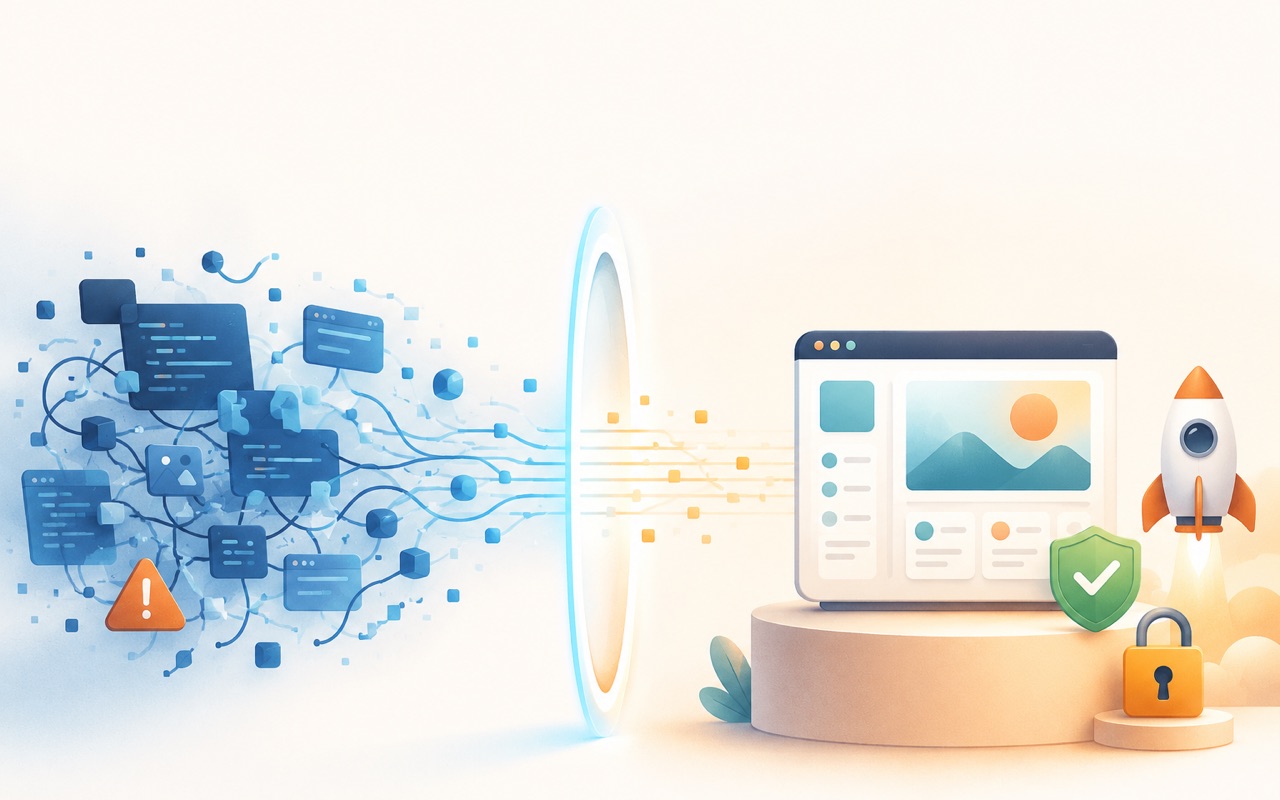
We take an honest look at your AI-generated software and tell you where it stands: what is good, what is solid, where the risks hide, and what is missing before it is ready for real use. Then we finish it. We clean up the code, close the security and privacy gaps, make sure the whole thing holds up under load, and put it properly on the internet. What you are left with is no longer a prototype, but a product you can put in front of your users with a clear conscience.
The process is deliberately uncomplicated, because most people who show up with a project like this have no appetite for big IT processes, they just want to see their thing online.
First: you send us what you have, whether that is a single HTML file, a repository, or a chat log with half the app inside it. Second: we take a look and give you an honest assessment of what it needs, what it costs, and what is realistically possible, without the jargon. Third: you decide whether and how far you want to go, from a simple "have a look and make it safe" all the way to fully building and running it. Fourth: we make it happen, and in the end you have something that is yours and works.
This is not grey theory for us. I build this way myself. My macOS app Frame Share came about on exactly this path: an idea, then a working state built together with AI, and then the part that really counts, getting it clean, published, and into the Mac App Store. So I know both sides of this gap from my own experience, and I know how the frustration feels when the last stretch of the road is suddenly steeper than expected.
That last stretch is exactly what we take off your hands. You had the idea and the courage to start it with AI, which is the hard, brave part. The unglamorous, hands-on rest that turns a "kind of works" into a "works, and I trust it" is ours to handle.
If you, or someone you know, have built something with AI that is honestly too good to rot in a downloads folder, then get in touch. Just message me through the imprint or reach out directly at Lulububu. We will take a no-obligation look and tell you openly what it could become.
The moral of the story? Thanks to AI, starting software is easier than ever. Finishing it is still its own discipline. But you do not have to walk that second half alone, and that is a pretty good piece of news.