Robothomas
from in-house tool to product
Attention: This page contains partner and advertising links. Therefore this page is to be understood entirety as an advertisement!
Until a few days ago, anyone who opened robothomas.de simply ended up on the website of my company Lulububu. Now it has a page of its own, and right at the top it asks a question I have been asking myself for years: "Who actually handles the paperwork?"
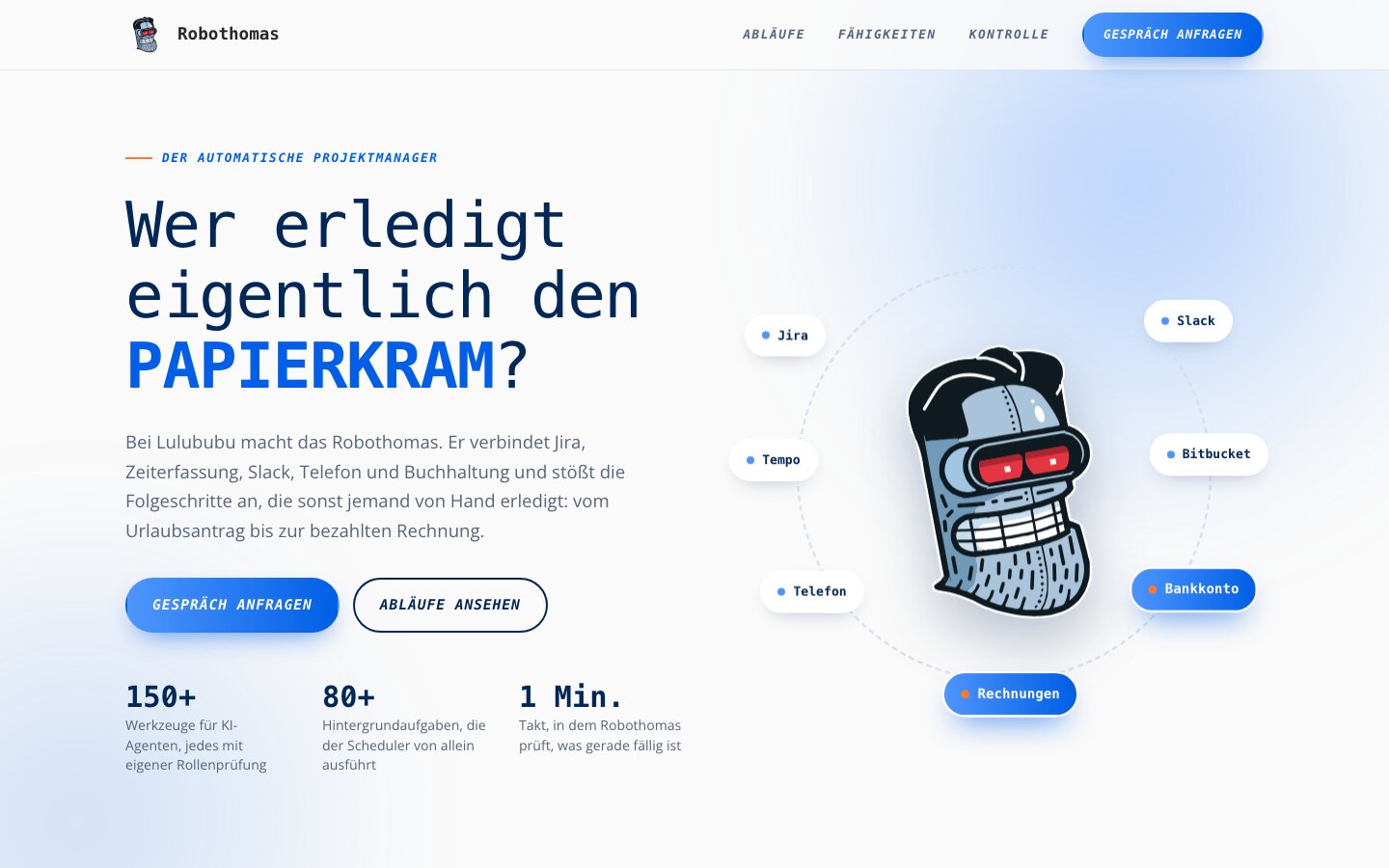
At our place, Robothomas does. He connects Jira, time tracking, Slack, the phone and accounting, and takes care of all the follow-up steps someone would otherwise have to do by hand, from a vacation request to a paid invoice. He started out as a small in-house tool. Now Robothomas is a product that we offer to other companies as well.
I am taking this as an excuse to tell the story behind it. It is written down in more than 7,000 commits, and it taught me something I did not want to accept at first: An automation almost never pays off on the first try. Most of the time it only really works on the third or fourth.
In January 2023 I already described what a day with Robothomas (in German) looks like. Back then he took care of well over 100 scenarios: He held back subtasks until a feature was due according to the project plan, reminded people of missing code reviews in Slack, organized our daily standup and followed up whenever a ticket had been sitting around for more than 30 days.
Two passages from that article make me smile today. When someone requested vacation, Robothomas suggested a fitting text for their out-of-office reply, and everyone had to set it up themselves. And since our phone system at the time had no API, he created a ticket for every vacation so that a human would change the call forwarding by hand. Both were automation. In the end, a human still sat in front of it and clicked.
The repository Robothomas lives in today starts on August 8, 2021, with a React skeleton and a page that listed our open pull requests. It showed who still owed a review, grayed out finished pull requests and put a crown on the author's avatar. There was even a dedicated state for when my approval as managing director was still missing.
After that, not much happened in this repository for a long time: 79 commits in 2021, 36 in 2022, 67 in 2023. In June 2024 a new backend based on Symfony arrived, with webhooks that let Jira and Bitbucket report every change right away. Recurring tickets followed in December 2024. And in March 2025, several people from the team suddenly worked on Robothomas at the same time: 191 commits in a single month, more than in 2022 and 2023 combined.
Since then the curve has only known one direction. 2025 brought 1,164 commits, 2026 already 3,491 up to November 8, and October alone 835. Since May 2026, several AI agents often work on Robothomas at the same time, each in its own copy of the repository. Whatever they finish, they merge through a shared integration branch. The way we work is written down in our own skill library for Claude Code, which has been growing since December 2025: implement a ticket, review your own change, write a proof into the ticket.
Of course, commits do not measure performance. AI agents commit in smaller steps than humans, and a commit can be a single line or an entire feature. But the curve shows quite well how much the pace has changed.
When I look at the history of individual workflows in Robothomas, I almost always see the same four rounds. In the first one, Robothomas makes something visible: a list, a status, a ticket. In the second, he reminds people when they forgot something. In the third, he suggests what to do. And only in the fourth does he get it done himself, and a human only has to approve where it really matters.
The first two rounds feel like progress but hardly save any time. The time is only saved once nobody has to click along behind the automation anymore. Three examples from our daily work:
The phone. In 2023, Robothomas created a ticket for every vacation so that someone would change the forwarding in the phone system. In July 2026 our contacts moved into an app of their own inside Robothomas. Since October, an AI phone assistant answers our calls: It recognizes who is calling, checks who on the team is available right now, and either puts the call through or creates a callback ticket with a summary and a transcript. One week after the launch, our phone statistics already came from Robothomas instead of the old system. Today the old phone system barely shows up in the code anymore, apart from the documentation.
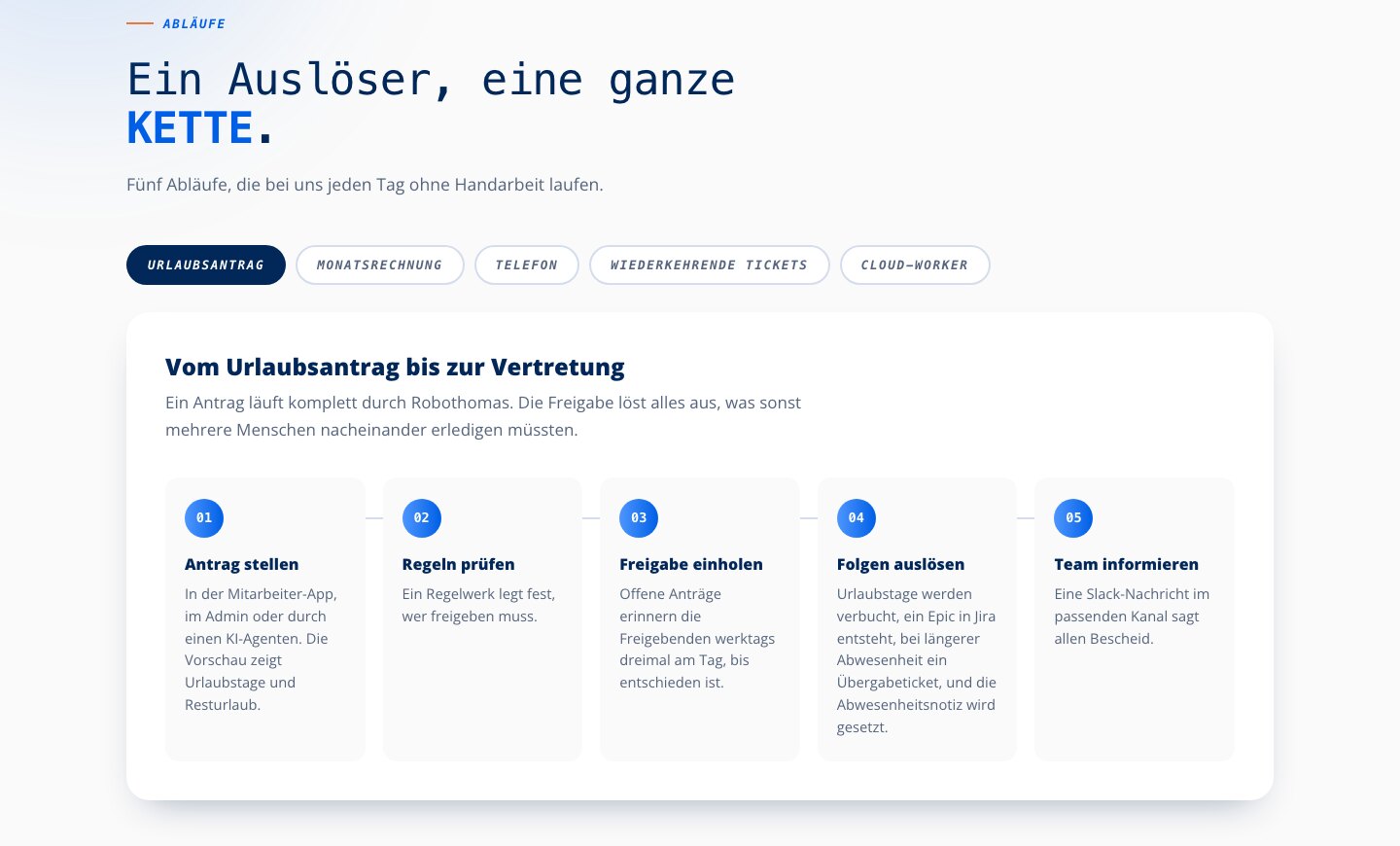
Vacation. In 2023, a vacation request went through Jira as a ticket, and Robothomas suggested the text for the out-of-office reply. In January 2026 he learned how many vacation days everyone has left. Since early November, the request is made directly in Robothomas, in the employee app, in the admin or through an AI agent. A set of rules decides who has to approve it, open requests send reminders three times per workday, and once a request is approved, everything else happens on its own: The vacation days are booked, an epic is created in Jira, a handover ticket for longer absences, the out-of-office reply is set and the team gets a Slack message. Nothing is being suggested anymore.
Between 2023 and today there were many small rounds you never see from the outside: part-time employees, public holidays that fall on someone's day off, half a day of special leave on Christmas Eve. Exactly these exceptions are where the first version of almost every automation fails.
Pull requests. In 2021, Robothomas listed them. In 2023, he reminded people of missing reviews and published the code automatically as soon as all of our rules were met. Today, AI agents implement tickets themselves, have their change reviewed by several specialized reviewers before pushing and merge it. Since October, the LuluHive has been handing out marked tickets to workers on machines of their own, which process every task in an isolated copy of the repository.
The first version of an automation handles the normal case. But the normal case is rarely the problem, otherwise nobody would have wanted to automate it. As soon as the first exception goes wrong, the team starts double-checking everything, and from then on the automation costs more time than it saves.
The second version knows the exceptions, but it is still an island. Between the systems, there is still a human carrying data from one place to another: from the vacation request into the calendar, from the calendar into the phone system, from the phone system into the ticket.
Only the third version is connected to its neighbors. One trigger sets off a whole chain, and the human is no longer the glue between the tools. The fourth version then cleans up: The old way disappears, and nobody does it by hand once more "just to be safe". Only then is the time really saved.
Whoever stops after the first round will think automation is overrated. I get that, I could have stopped in 2023 after the phone system tickets. But every round leaves behind interfaces and data the next one can build on. I wrote that back then, and today it is truer than ever.
Robothomas does not replace tools, he connects them: Jira, Tempo, Confluence, Bitbucket and Slack, the bank transactions from Qonto, PayPal and Volksbank, Twilio and the voice assistant from Retell. On robothomas.de we present five workflows that run at our place every day without manual work: the vacation request, the monthly invoice from the booked timesheet to the incoming payment, the phone, recurring tickets and the cloud workers from the LuluHive.
Behind it are more than 150 tools for AI agents and more than 80 background tasks that the scheduler runs on its own. Every minute, Robothomas checks what is due right now. By now the repository holds more than 20 apps of its own, from the employee app and the liquidity plan to planning poker.
So why a product? Because the routines that cost us time are not a Lulububu specialty. Vacation requests, monthly invoices, callbacks and recurring tasks exist in every company, and I believe most of them are stuck somewhere in round one or two. We have already been through several rounds for our own workflows. Others do not have to start from scratch.
Things get really exciting now that AI agents can work with Robothomas. Since July 2026, Robothomas has had an MCP server: Through the Model Context Protocol, agents like Claude call his tools directly. It started out as read-only access to the liquidity plan and the recurring tickets. Today, an agent creates the draft of a monthly invoice including the timesheet on request, searches meeting transcripts, files a vacation request or calculates in the liquidity plan what one more hire would mean for our bank balance.
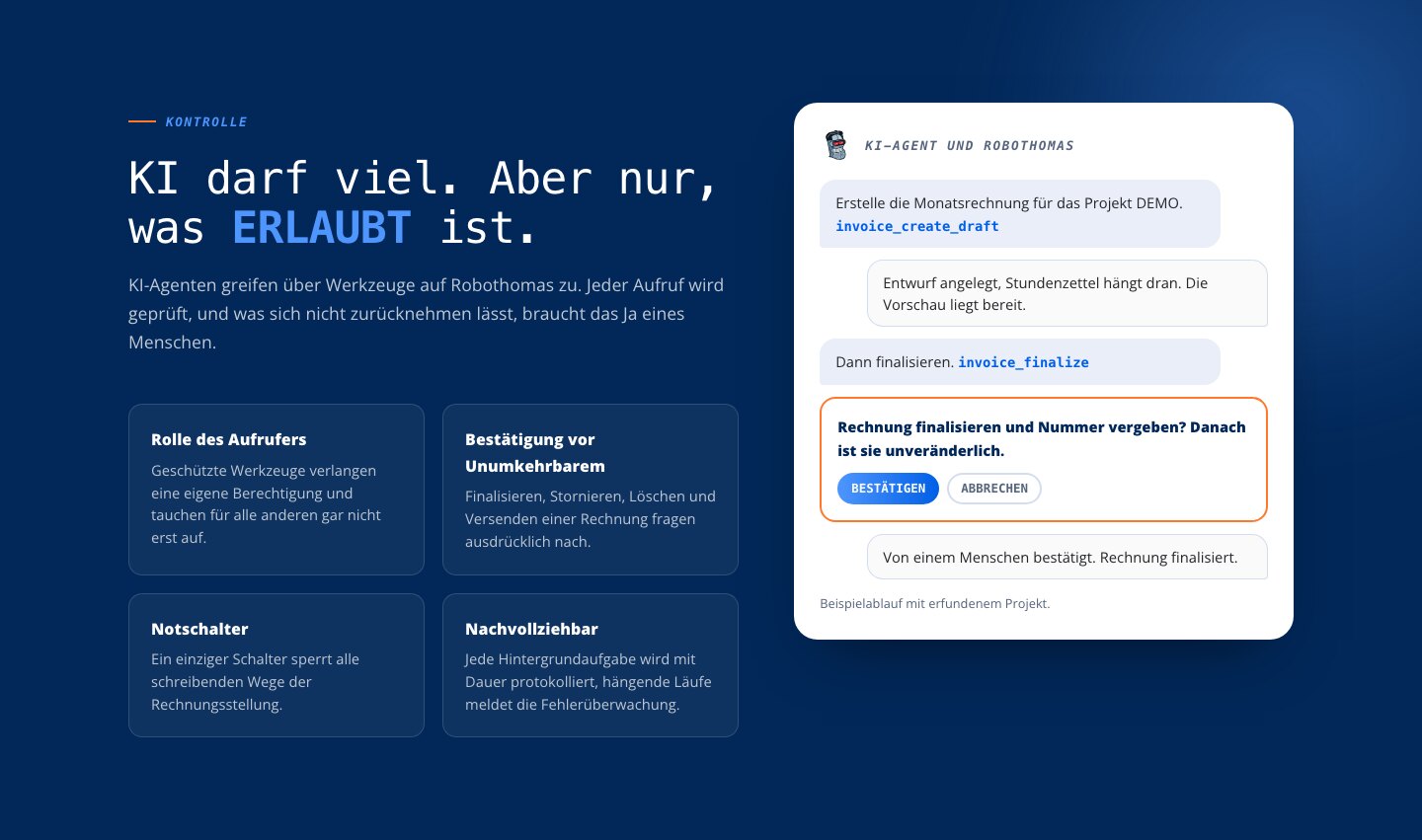
The most important rule is stated on robothomas.de in a single sentence: "AI may do a lot. But only what is allowed." Every tool checks the role of whoever calls it. Anything that cannot be undone, such as finalizing, canceling or sending an invoice, needs the explicit yes of a human. And a single kill switch blocks every writing path of the invoicing.
On top of that comes the effect that surprised me the most: Robothomas now helps build Robothomas. He stores an assessment of complexity and effort for finished tickets, and the LuluHive picks up marked tickets, works through them and reports the progress back to Jira through Robothomas. Every round makes the next one cheaper.
In 2023 I wrote that we had managed to avoid hiring a dedicated project manager so far, because every time we would have needed one, a new stage of our automation came along. Today the website of Robothomas says: The automatic project manager. And I believe we are only at the beginning. Once the data and tools of a company are cleanly connected, an agent can combine them in ways nobody ever programmed one by one. Honestly, that is exactly the part I find mind-blowing.
If your company has a routine that eats up time every week and you have long been thinking that a computer should really be doing it: Take a look at robothomas.de or drop me a line. Show us the workflow that still runs by hand today, and we will show you what Robothomas can already do with it.
And if you are sitting on an automation right now that just does not want to pay off: Give it two more rounds.