Toni & Freunde
calm kids' songs instead of AI slop
Attention: This page contains partner and advertising links. Therefore this page is to be understood entirety as an advertisement!
There is a kind of YouTube video I can now spot within three seconds: garish colors, a new picture every few seconds, something is always flashing somewhere, and the music sounds like a basement party. The characters look a little different in every scene, sometimes there is an extra wheel, sometimes an eye is missing, and nobody in the video seems to notice. Welcome to the world of AI slop for kids: videos an AI churns out on an assembly line, as fast and as cheap as possible, so the algorithm always has something to play next.
My son wanted to watch exactly these videos. Again and again. And every time, they annoyed me a little more, until I decided to take the reins myself. The result is Toni & Freunde (Toni & Friends): a German kids' channel with calm songs for two- to five-year-olds, with characters that never change, and with its own website for parents.
Let me get one thing out of the way: I have nothing against AI. I work with it every day and have written here before about how we turn AI-built software into real products. My problem was never the tool, but what is being done with it.
The pace. Small children need time to take in a picture, to point at it and to sing along. These videos don't give them any: the next cut arrives before the child has caught up with the last one. That keeps the eyes glued to the screen, but it is sensory overload, not a song.
The characters keep changing. An image or video AI that generates every scene from scratch no longer knows exactly what the tractor looked like a moment ago. For adults, that is a funny glitch. For children who are just learning to recognize things, it is the opposite of what they need.
It never ends. As soon as one video is over, the next one starts. There is no natural ending, and every time you switch it off, it feels like taking something away from your child in the middle of a sentence.
On November 5 at 7:08 pm, I recorded a voice memo that basically said: "Prompt a YouTube kids' channel, with slow videos and cute cartoons." My digital assistant Robothomas turns notes like that into a Jira ticket automatically. The next morning, it became a proper task: a playful but not too complex setup, an asset book with the characters, and an automation that turns a finished song into a matching music video. Two sentences in it mattered most to me: The characters must not change during the video. And: The video should be suitable for children and not that fast.
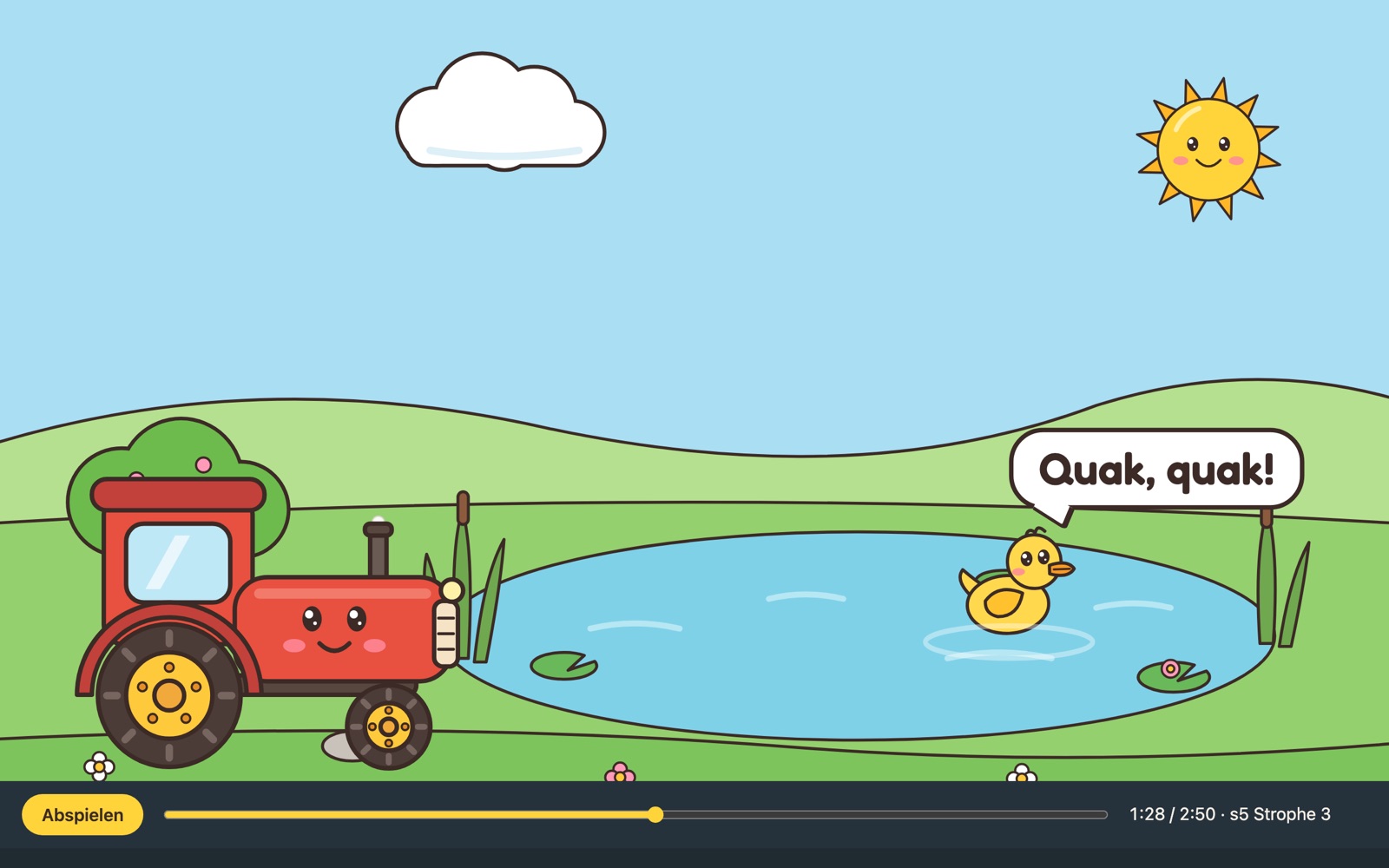
A little more than 24 hours after the voice memo, the first six songs were on YouTube. This is the very first one:
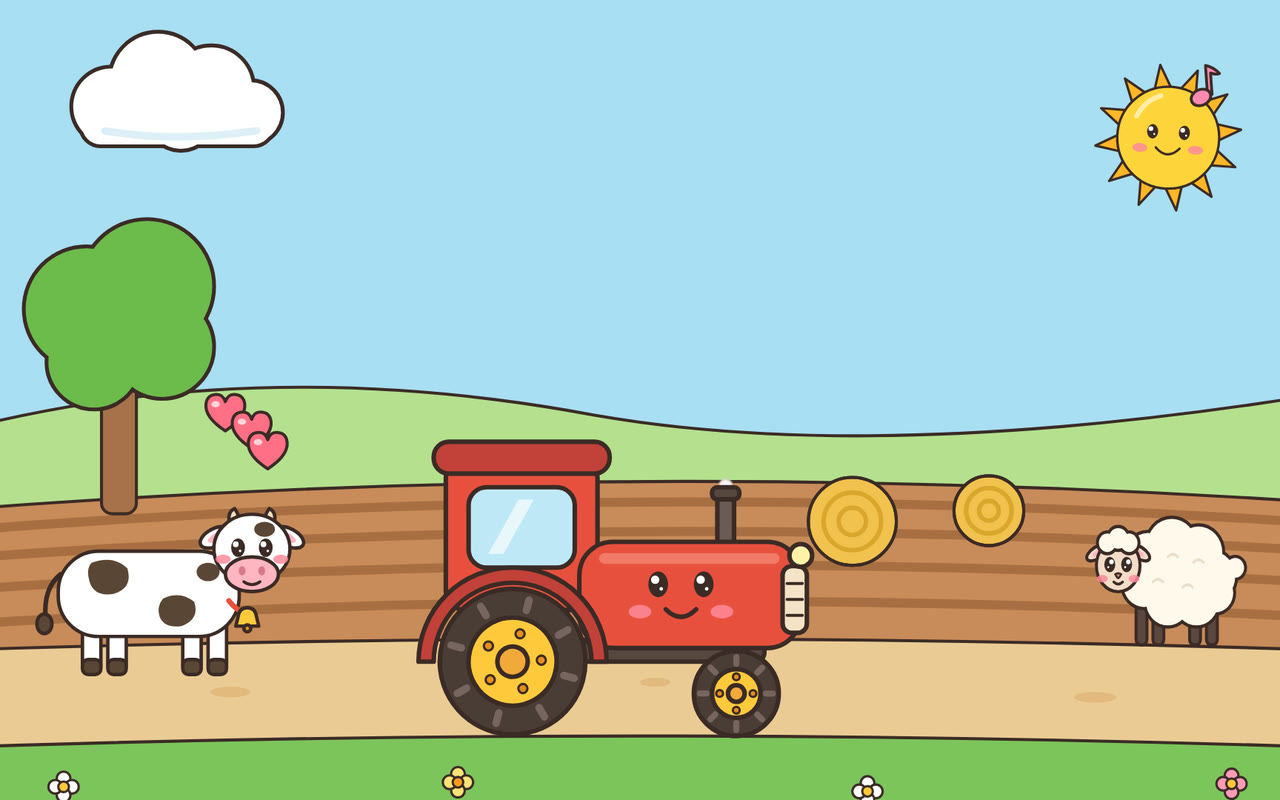
If the problem is that an AI reinvents every scene, the solution is obvious: it must not draw the characters in the first place. Every character is a fixed SVG drawing in a kit, and every video uses exactly these files. Only parts like wheels, eyes, mouth and head move, never the drawing itself. That is why Toni the tractor looks exactly the same in every scene and in every video.
It started with six characters: Toni Traktor (the tractor), Moritz Müllwagen (the garbage truck), Sonja Sonne (the sun), Klara Kuh (the cow), Wolle Schaf (the sheep) and Emil Ente (the duck). By now, 43 friends live in 23 sets, all in the same flat, round style with faces built the same way.
On top of that, there are rules that are surprisingly fun to write: characters never wear clothes, a hat is a prop. Only humans may wave, vehicles honk and animals call. In our world, the fire truck waters flowers and the police helps Emil the duck across the street. Anger, sadness or fear of the dark may appear, they get a name and resolve gently: breathe, comfort, cuddle.
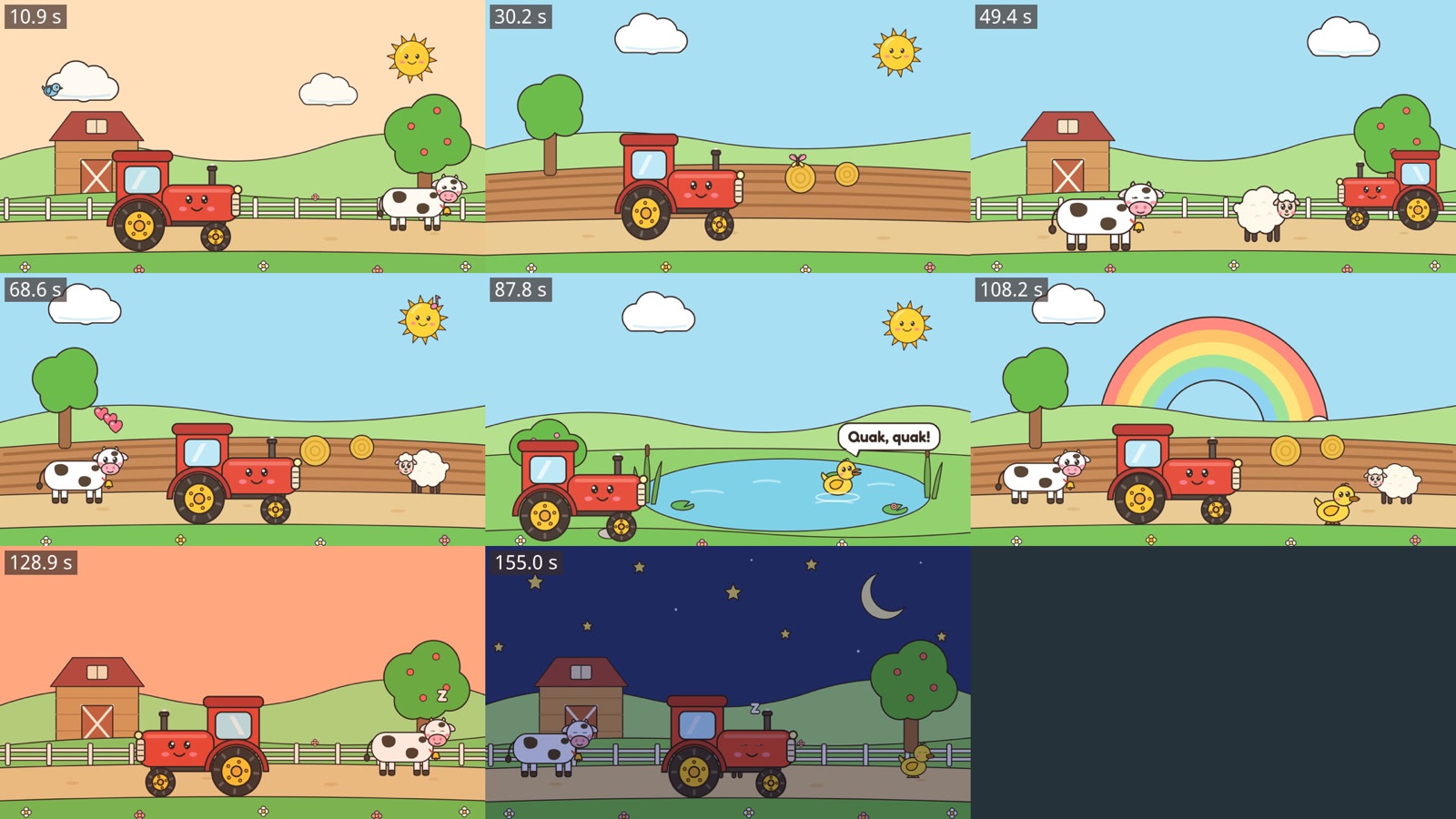
This is the part I enjoy most as a developer: every scene is a web page made of HTML, SVG and CSS. A small timeline computes every frame as a pure function of time, so I can play every video in the browser beforehand and jump back and forth in it. Rendering happens frame by frame in a headless Chrome straight into ffmpeg, at 1920 × 1080 pixels and 30 frames per second. No npm packages, everything runs locally, and a three-minute song is done in about one minute.
I built the whole thing together with Claude Code as a so-called skill. First, the lyrics are written, using only characters, places and movements that actually exist in the kit. The music is made by Suno, an AI music generator. A script finds the tempo, bars, verses and choruses in the finished song, and that is what the storyboard is built from: one scene per part of the song and a picture for every line, with a movement right on the first beat of the bar. The chorus always returns to the same place, and the ending picks up the beginning: the sun rises in the morning and sets in the evening.
The most important part is a checker that validates every storyboard before it is built: scene lengths, speeds, camera moves and how long a text stays on screen. If it complains, the rule is not bypassed, the storyboard is made calmer instead. Uploads go through the official YouTube API, always as "made for kids" and always private first. A video only goes public once a human has watched and listened to it.
The music follows equally strict rules: no German Schlager, no cheesy "hooray", natural voices instead of jingle noise, a comfortable 90 to 110 beats per minute, lullabies even slower. The chorus is repeated three times word for word so even the little ones can sing along quickly, and there are moments for clapping, nodding and counting. Every lyric is newly written, and the style changes from song to song, from lullaby to folk, bossa nova and swing. There is an entirely selfish reason for that: I want to still enjoy the song the tenth time I hear it.
My favorite detail is the ending. Every video closes with a 30-second good night break without music: all characters fall asleep under the moon and stars, they say "Gute Nacht!" and "Bis bald!" (good night, see you soon), and then the picture slowly fades to black.
Instead of the next video starting seamlessly, things quiet down first. That is the moment to switch off, and it doesn't feel like an interruption, but like an ending. The generator adds this break to every video automatically, and it can't be shorter than 30 seconds.
One problem remains: whoever watches Toni & Freunde on YouTube immediately gets exactly the videos suggested next to it that I was trying to escape from. That is why there is toniundfreunde.de, a dedicated website where parents can find every song without an algorithm having a say.
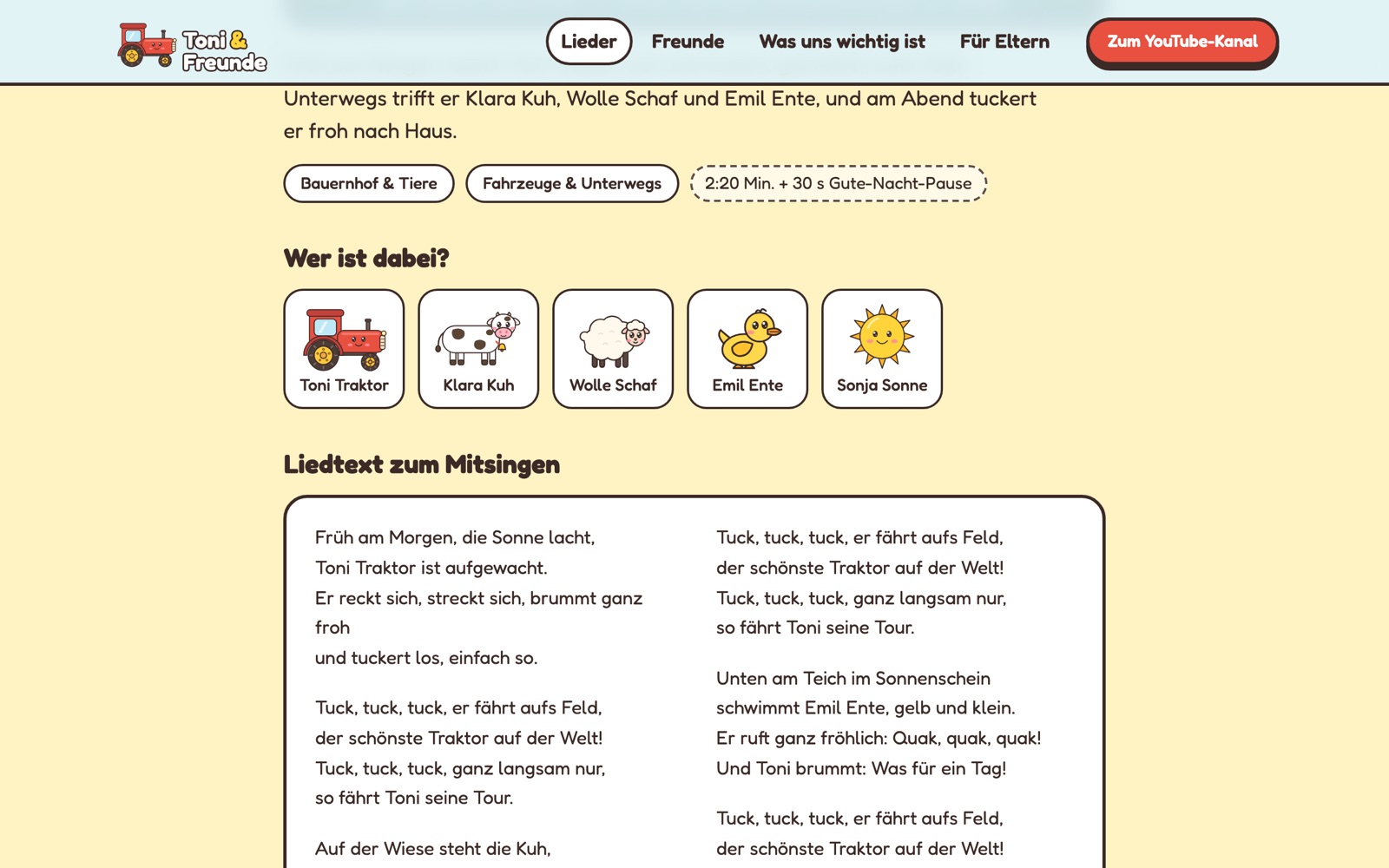
The website is static HTML without a framework, generated by a single build script from the same folders the videos are made from. The script reads which videos are already public from the channel's feed, and after every upload the site is simply rebuilt. The song list already contains 153 songs and introduction videos, most of them so far as a finished script with lyrics, the videos follow one by one. You can search by title, character, topic or any line from the lyrics, and every song has its own page with the video, the cast and the complete lyrics to sing along.
In the "friends" section, every character introduces itself, and in the "what matters to us" section, a fitting character explains each rule of the channel: Susi the snail says "We have time.", Lumi the lighthouse says "I'm watching out." For parents, there are texts about what makes a song calm and how much screen time makes sense. The WHO recommends no more than one hour a day for two- to four-year-olds, the German guideline no more than 30 minutes on individual days for three- to six-year-olds. That is why the website openly says: one or two songs are a good portion. A sentence a slop channel would probably never write.
And because it is about children, the website is technically restrained as well: no cookies, no external fonts, and YouTube only loads once you click "play video".
Yes, I see the irony. I complain about fast-produced AI videos and set up an entire channel in less than two days myself, with AI. The voice memo on Thursday evening, the first six songs on YouTube on Friday evening, the website on Saturday. By now, more than 120 songs are ready as finished scripts.
The difference is not the tool, and not how fast something gets made, but how fast the result is, and the rules behind it. At Toni & Freunde, the AI writes lyrics, storyboards and code. But every character is a fixed drawing, every storyboard has to get past a checker that simply forbids hectic pacing, and no video goes online before a human has seen and heard it. Building fast is not the problem. Cutting fast is.
Whether Toni the tractor can hold his own against the garish competition in the long run will not be decided by the algorithm, but by a pretty tough critic at home. At least I now know what he sees when he watches Toni: a song with a little story, friends he recognizes every time, and at the end 30 seconds of quiet in which I can switch off.
If you have kids between two and five yourself and they understand German: feel free to stop by toniundfreunde.de or subscribe to the channel on YouTube. Toni & Freunde is a project of my company Lulububu, and if you have an idea for a song or a new character, drop me a line. Toni is always happy about new friends.